Dune: Tokenized Stocks and ETF On-Chain Trading Volume Exceeds $37 Billion, Monthly Trading Volume Increased Nearly 18 Times Compared to January

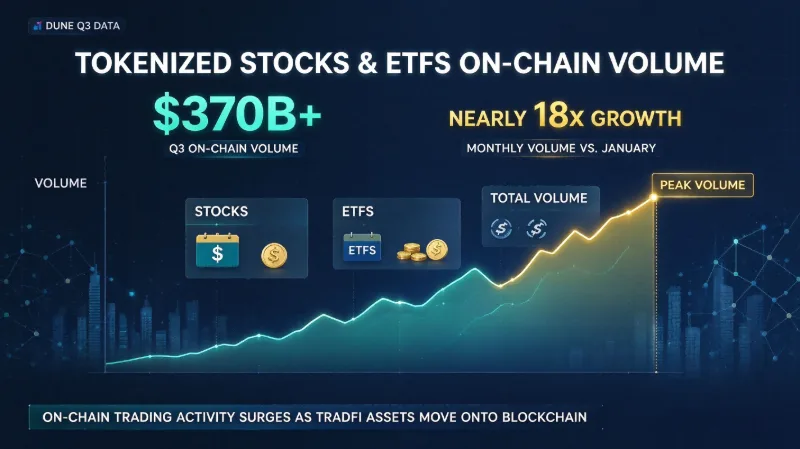
According to Dune, the on-chain trading volume of tokenized stocks and ETFs in the third quarter exceeded $37 billion, with monthly trading volume increasing nearly 18 times compared to January, covering more than 200 trading venues and 12 blockchains. During the same period, the trading volume of perpetual contracts linked to stocks, ETFs, and stock indices on Hyperliquid reached $201 billion.

· 1 min read
Dune: Tokenized Stocks and ETF On-Chain Trading Volume Exceeds $37 Billion, Monthly Trading Volume Increased Nearly 18 Times Compared to January

October 23, according to a report from the on-chain analytics platform Dune cited by Bloomberg, the on-chain transaction volume of tokenized stocks and ETFs in the third quarter exceeded $37 billion, with monthly transaction volume increasing nearly 18 times from January 2026. The statistics cover more than 200 trading venues and 12 blockchains. At the same time, the perpetual contract trading volume on the decentralized perpetual contract platform Hyperliquid, which is linked to stocks, ETFs, and stock indices, reached $210 billion. Dune also pointed out that about 25% of the spot trading of crypto assets is currently conducted on-chain.

Raed's Perspective The quarterly transaction volume of $37 billion itself is not the biggest number, but the fact that the monthly transaction volume has increased nearly 18 times from January reveals a key turning point in the RWA sector: tokenized stocks and ETFs are moving from 'issuance and holding' to the 'high-frequency trading' stage. The industry's previous focus was on the issuance scale, while the surge in transaction volume indicates that tokenized assets are being actually used and circulated within the on-chain ecosystem. For RWA related to brand assets and operating rights, the reference value of this data lies in: the trading activity after being on-chain, rather than the issuance scale, is the indicator of whether RWA is truly embedded in the on-chain financial system.

Market Analysis · Industry Trends · Tokenisation

More to read

  • Dubai's Scintilla Distributes US Hotel Revenue Interests via USD1 Stablecoin; VARA-Licensed Entity Serves Only as Distributor

    Dubai's Scintilla Network announced on November 27 that it has opened tokenized US hotel revenue products to UAE and international qualified investors through the GreatX platform. Participants deposit USD1 stablecoins into property-specific vaults custodied by BitGo in exchange for GRTX positions linked to hotel operating profits, with returns distributed quarterly in stablecoins. Scintilla holds a VARA broker-dealer license but clarifies that it serves solely as a distributor and does not act as issuer, debtor, or manager; the tokens themselves do not define rights, and specific entitlements are entirely governed by the offering documents.

    · Global News

  • The timing of hotel tokenization: why the "verified revenue-generating part" is the best target for on-chain

    On November 26, industry analyst Roberto Simone wrote in Hospitality Net that the tokenization of hotels and mixed-use projects should not be positioned as a financing tool in the project launch phase, but as a capital option in the mature stage - tokenizing the parts that have already proven their revenue-generating capabilities (such as mature retail, stably operated hotel areas) to face retail investors on digital asset platforms. This judgment clearly differs from the current industry's narrative of tokenization as "development phase financing".

    · Global News

  • The Hong Kong Monetary Authority launches the CMU digital asset platform, with bond tokenization included in the official settlement infrastructure, and the next step is to expand to RWA

    On November 25, the Hong Kong Monetary Authority announced the launch of the CMU digital asset platform, operated by Hong Kong Exchanges and Clearing, which supports the complete life cycle of bond tokenization based on distributed ledger technology - primary issuance, secondary trading, clearing and settlement, dividend payment and maturity redemption. It adopts on-chain atomic DvP settlement and is directly connected to RTGS and CBDC, allowing for 24-hour multi-currency settlement. Hong Kong Exchanges and Clearing plans to extend the platform's coverage from bonds to other asset classes such as funds and RWA, and connect tokenized deposits with regulated stablecoins.

    · Global News