Under the SEC's innovative exemption, the first three institutions plan to operate tokenized securities trading venues, with Canton, OKX, and Kronos making multi-chain progress
The SEC disclosed that three institutions have notified plans to operate tokenized securities trading venues (TSV) under the new innovative exemption framework: TSV LLC based on Canton Network, OKXICE jointly operated by OKX and ICE on X Layer, and Kephas Corp. based on Kronos X Public. The exemption framework is valid for five years, allowing licensed AMM transactions of NMS tokenized stocks.
· 2 min read
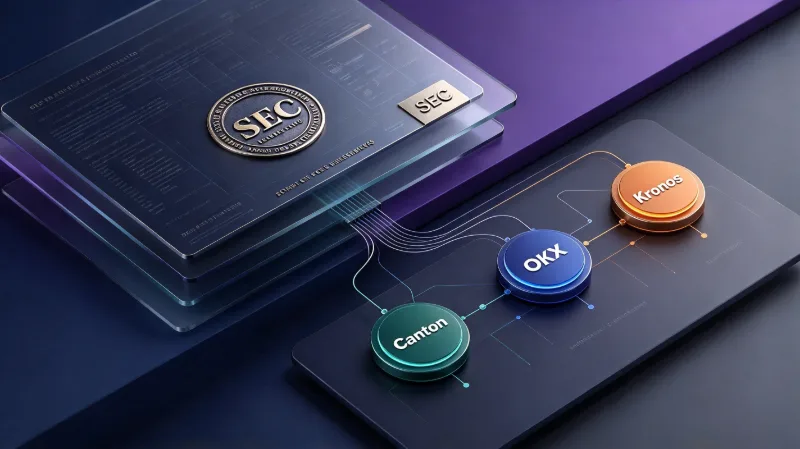
From October 21 to 22, the U.S. Securities and Exchange Commission (SEC) disclosed that three companies have informed it of their plans to operate tokenized securities trading venues (TSVs) under the new innovation exemption (Innovation Exemption) mechanism.
The three institutions have selected different underlying networks: TSV LLC, held by the co-founder of Obsidian Systems, plans to operate on Canton Network; OKXICE, a joint venture between OKX and the Intercontinental Exchange (ICE), plans to operate on OKX's Ethereum Layer 2 network X Layer; and Kephas Corp., led by the former head of FTX Europe, plans to operate on the public, permissionless Layer 2 network Kronos X Public that uses a licensed trading pool. The SEC clearly stated that being listed on the notice does not mean the relevant companies have met all the conditions for the innovation exemption.
This innovation exemption originated from SEC Release No. 34-106402, establishing a time-limited exemption framework for five years for secondary trading of tokenized stocks in the National Market System (NMS) through licensed automated market makers (AMMs) and liquidity pools. TSVs must publish a notice on a public website at least 30 days before starting operations, including the required disclosures, and clearly list the tokenized NMS stocks, non-security cryptocurrencies, and tokenized money market funds that can be traded. SIFMA submitted a comment letter on October 19, requesting the SEC to address key outstanding issues before the TSVs go live.
Red Perspective: This is the first complete institutional channel in the history of RWA regulation for operating a tokenized securities trading venue with an exemption license. The three institutions have chosen Canton (institutional-level licensed network), X Layer (Ethereum L2), and Kronos (licensed trading pool L2), indicating that the SEC's exemption framework does not predefine a single technical path, but rather focuses on 'disclosure + licensed AMM' as the core constraint. For RWA-related brand assets and operating rights, the significance of the TSV framework lies in: the access threshold for compliant trading venues is shifting from 'licensed exchanges' to 'disclosure + technical standards that meet exemption conditions'. In the future, the design of circulation venues for non-standard RWA may refer to this 'limited exemption + continuous disclosure' structure, rather than waiting for full licensing.